

MARKET REVIEW FOREX FED
Warsh Puts AI at Centre of Fed’s Long-Term Policy Thinking
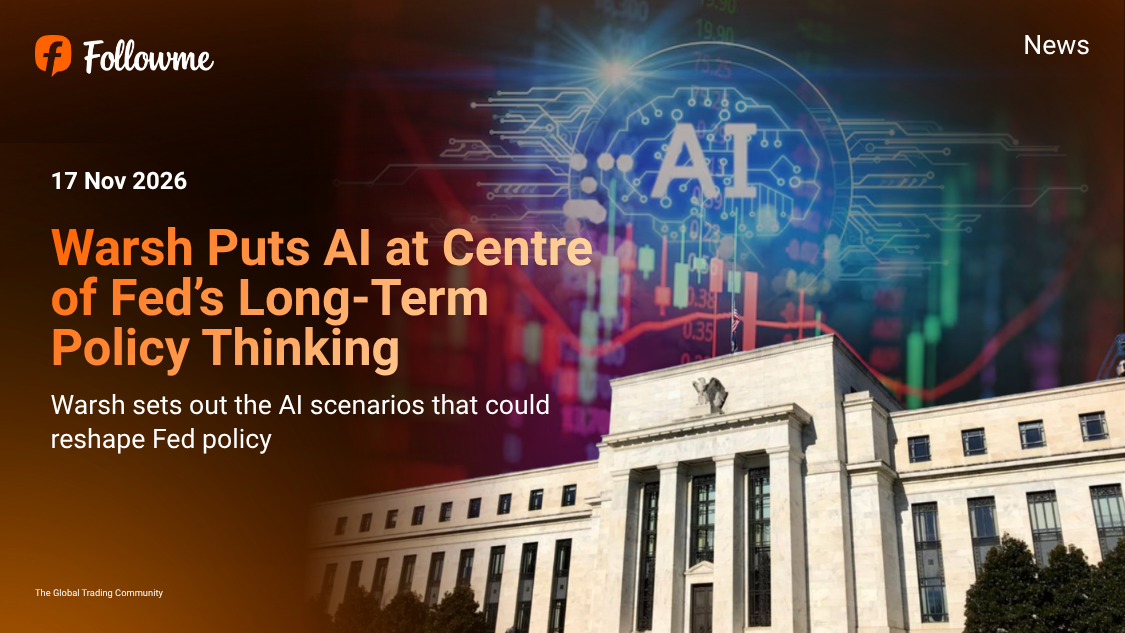
Fed Chair Kevin Warsh’s first speech at a Reserve Bank looked past December’s expected hike to a bigger question: how super intelligence could change growth, jobs and monetary policy. The dollar was held at a 19-month high.
Followme News Desk | November 17, 2026
Executive Summary
Fed Chair Kevin Warsh used his first visit to a Reserve Bank as chair to set out how the Federal Reserve is thinking about artificial intelligence. Speaking at the Productivity and Jobs Task Force conference in San Francisco on Monday, Warsh called super intelligence (SI) a general-purpose technology that could “supercharge idea generation” and keep US growth above its long-run average.
Fed staff presented three scenarios: broadly shared gains with full employment, strong growth with job losses that push unemployment higher, and a disappointing outcome in which AI investment returns fade, equities fall and the economy slows. Warsh said they were “illustrative scenarios, not forecasts.” He also said SI will carry “important implications for monetary policy down the road.”
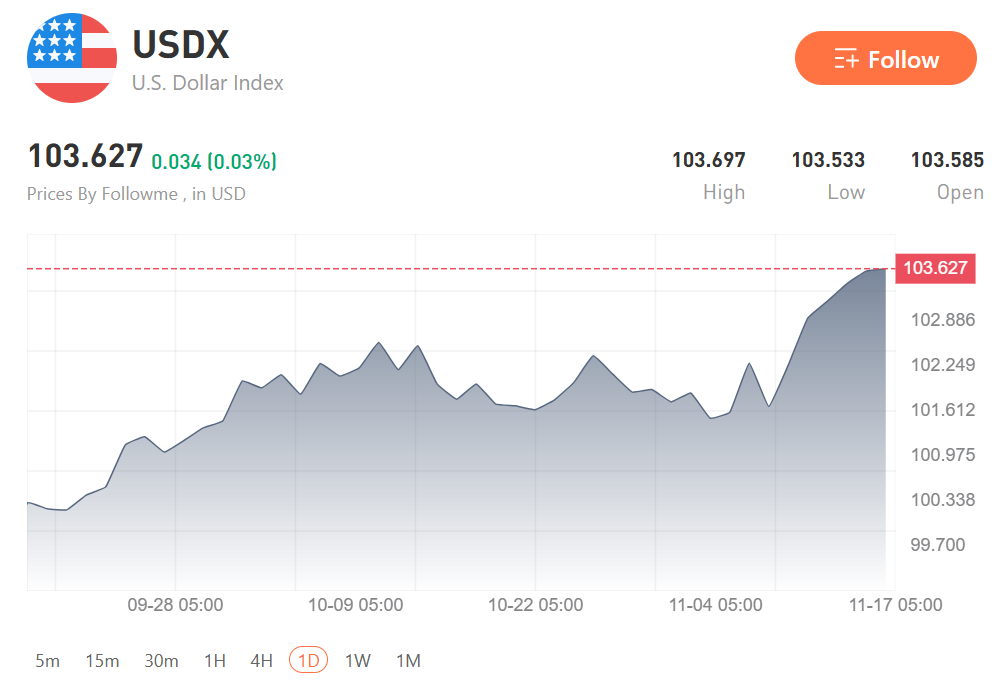
He gave no guidance on December. Markets didn’t need it. The dollar index held at 103.50, its highest since April 2025, with a 25bp hike on December 9 priced at 93.4%. For traders, the speech matters less for this month and more for 2027. It shows the risks the Fed is preparing for after the current tightening cycle ends.
Market Review
Kevin Warsh chose an unusual moment to look further ahead. With a December rate hike almost fully priced and the dollar on a five-session winning streak, the Fed chair spent his San Francisco speech on long-term growth, idea generation and super intelligence instead of near-term rates.
His argument draws on endogenous growth theory, the idea that living standards rise when an economy keeps producing new ideas. Warsh said idea generation has slowed for decades: research efforts have grown sharply since the 1930s, but breakthroughs have become harder to find. Slower population growth adds to the problem, since fewer people means fewer new ideas. That is why secular stagnation came back into the debate after the financial crisis.
Super intelligence, in Warsh’s view, could change that. Unlike earlier technologies, it may automate the creation of ideas itself. “The marginal cost of satisfying limitless curiosity… is falling fast, perhaps even trending toward zero,” he said. He was careful not to overstate where the US is today. Productivity growth has been reasonably strong, but “it hasn’t yet broken out definitively and structurally to the upside.”
The most market-relevant part of the speech was the staff scenario work. In the first case, SI gains are shared across workers and capital owners, real GDP growth stays above its long-run average, and the economy remains near full employment. Secondly, growth still rises but automation displaces jobs. Combined with labour market frictions, that “could push the jobless rate above levels consistent with full employment.” In the third, returns on heavy capital investment disappoint, equity valuations fall, and the economy slows with “a more notable rise in unemployment” before recovering without the promised productivity gains.
Warsh did not attach inflation or interest rate paths to any of these scenarios. He also stressed humility: “We can’t know the future and ought not to pretend otherwise.” He described the Fed’s job as contingency planning, not picking winners. He also flagged that SI “empowers all, including bad actors,” with critical infrastructure a particular concern.
The near-term picture is unchanged. October CPI rose 0.4% on the month and core rose 0.3%, keeping December hike pricing locked in. Cleveland Fed President Beth Hammack, who dissented for a hike in October, said on Monday she still prefers “smaller increments” but would back bigger moves if the Fed falls behind the curve. The 10-year Treasury yield is holding around 5.12%–5.14%, and USD/JPY is sitting near ¥159.50, close to the ¥160 intervention zone.
USDX price as of 17 November 2026 - View Live Chart →
The Facts
- Warsh speech: Opening remarks at the Fed’s Productivity and Jobs Task Force conference in San Francisco on November 16, his first visit to a Reserve Bank as chair. It is one of five task forces he has set up.
- Core message: SI is a general-purpose technology that could “supercharge idea generation” and lift growth above its long-run average.
- Productivity view: Recent productivity growth is solid but has not yet broken out “definitively and structurally to the upside.”
- Scenario 1, shared gains: GDP growth stays above its long-run average and the economy stays near full employment.
- Scenario 2, labour disruption: Growth rises, but automation pushes unemployment above full-employment levels.
- Scenario 3, disappointment: AI investment returns fall, equities drop, unemployment rises, and the recovery comes without productivity gains.
- Policy link: SI will have “important implications for monetary policy down the road.” The scenarios are “not forecasts.”
- No rate signal: The speech did not mention inflation, the neutral rate or the December meeting.
- Fed pricing: 93.4% odds of a 25bp hike on December 9 and about 10% odds of 50bp. The current range is 3.75%–4.00%.
- USDX: 103.50, its highest since April 2, 2025, after five straight gains.
- Hammack: Prefers gradual hikes, but larger moves are possible “if we get behind the curve.”
- 10-year Treasury: Around 5.12%–5.14%.
- USD/JPY: Near ¥159.50 after Japan’s Q3 GDP contracted 0.1% annualised.
- EUR/USD and GBP/USD: EUR/USD at 1.1009 and GBP/USD at 1.3190.
What It Means
Warsh’s speech won’t move December pricing, but it tells traders how the Fed is likely to think once the hiking cycle peaks. Two of the three staff scenarios end with higher unemployment. That matters for a central bank with a dual mandate. If AI-driven job losses start to show up in the data, the case for keeping rates restrictive gets weaker, even if growth looks strong.
The third scenario is worth noting in a market where tech valuations depend heavily on AI expectations. The Fed is openly modelling a case where AI capex disappoints, equities fall and the economy slows. With the Nasdaq already under pressure from 5% Treasury yields and Nvidia’s earnings due Tuesday, traders should not overlook that the Fed is planning for this outcome.
There is also a dovish undertone for the longer term. A genuine productivity surge, the first scenario, would let the economy grow faster without generating as much inflation. That would give the Fed room to ease sooner than a purely inflation-focused view would suggest. Warsh was careful not to claim that is happening yet, but he is clearly laying the groundwork for the argument.
For now, the dollar is still trading on rate differentials, and those favour the US. The Warsh speech mainly makes 2027 less certain. As markets start pricing beyond December, AI-related labour data and tech-sector earnings could become Fed-relevant inputs in a way they haven’t been before.
What Traders Should Watch
FOMC minutes (Wednesday, Nov 18): Watch for any discussion of AI, productivity or labour displacement alongside the hike debate. A mention in the minutes would show Warsh’s framework is spreading across the committee.
USDX at 103.50: A sustained break higher extends the rally into territory last seen before the April 2025 tariff shock. A stall ahead of the minutes would suggest December is fully priced.
Nvidia earnings and tech equities: These are a live test of the “disappointment” scenario. A sharp tech selloff would hit risk sentiment and could cap Treasury yields.
US labour data: Jobless claims and payrolls now matter for two reasons: the near-term hike path and early signs of AI-related job displacement.
10-year yield above 5%: As long as it holds, the dollar stays supported and gold and equities remain under pressure.
USD/JPY near ¥160: This is still the biggest near-term risk of a sudden dollar drop if Japan intervenes.
The Bottom Line Warsh did not tell markets what the Fed would do in December. He told them what the Fed is preparing for after that. For now, the dollar is trading on the hike, but positioning for 2027 will increasingly depend on whether AI delivers productivity gains, job losses or the disappointment Warsh laid out.
Follow us for daily market insights, analysis, and the tools you need to trade with confidence.
Want to stay ahead of major macro developments that move the market? 👉 Follow Followme and check out the Weekly Economic Calendar
November 17, 2026 | This report is for informational purposes only and does not constitute financial advice. © 2026 Followme News
Download Followme Application


Follow us on:


Tuyên bố miễn trừ trách nhiệm: Quan điểm được trình bày hoàn toàn là của tác giả và không đại diện cho quan điểm chính thức của Followme. Followme không chịu trách nhiệm về tính chính xác, đầy đủ hoặc độ tin cậy của thông tin được cung cấp và không chịu trách nhiệm cho bất kỳ hành động nào được thực hiện dựa trên nội dung, trừ khi được nêu rõ bằng văn bản.
 Chưa có bình luận nào. Hãy là người đầu tiên chia sẻ ý kiến của bạn.